
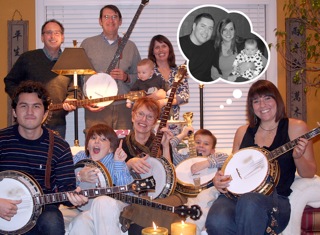
 Untroubled by persistent quarterly negative profit margins, the Banjo Rehabilitation Center support staff cheerfully celebrates the conclusion of another fiscal year with an annual Holiday greeting card photo. Because it is a small scale enterprise, the Banjo Rehabilitation Center is not cited in the major stock indices, has no prospectus, and is unable to attract major investors for expansion into the global market.
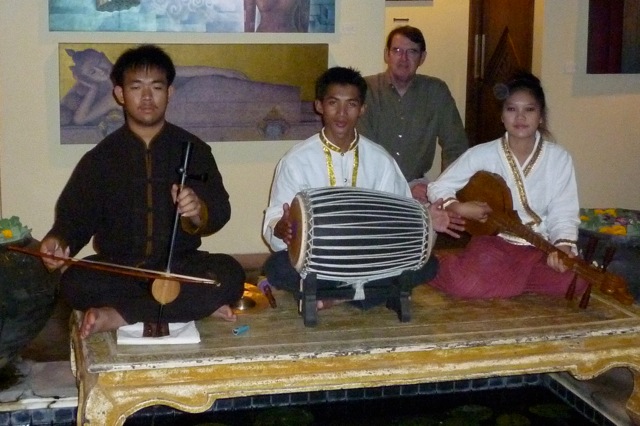 Although the banjo is considered by some to be a uniquely American musical instrument, the BRC founder has seen and appreciated its cousins in other cultures on distant continents.
In a trio of traditional Thai musicians, he enjoyed the “saw duang” which is a bowed mini banjo with a python skin head, the traditional “taphon” drum, and the “sueng” which has a wooden drum head.

As pictured along the shoreline of the upper Nile River, the BRC founder vocally echoed the tones of the lyre-like tambura to a surprised but pleased Nubian tribesman who responded, “No money,” when offered a tip by the singing American.
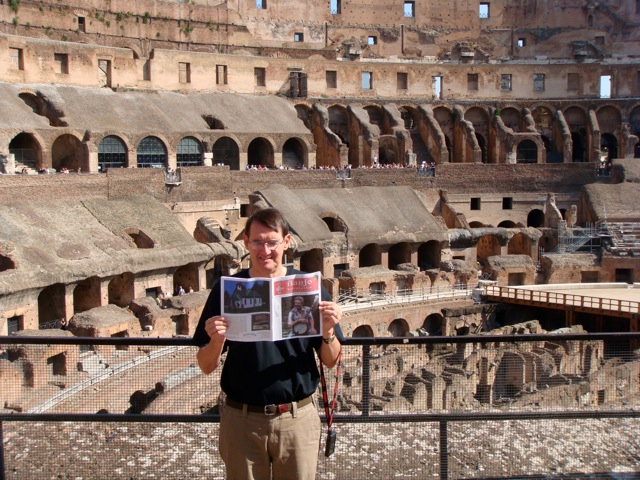 To comprehend the architectural principles of various interior banjo pot support systems, the Banjo Rehabilitation Center founder studied the larger model of the Roman coliseum. These ancient circular ruins helped him to grasp the advantages and disadvantages of dowel stick versus connecting rod supports (see BRC workshop photo).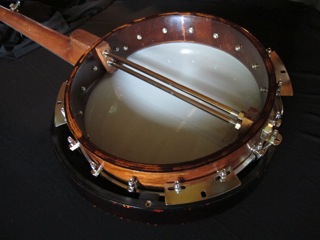
–
The Banjo Newsletter is a valuable educational resource for such vexing technical issues. Pictured on the cover of this edition of the BNL is banjoist Eric Weissberg, a boyhood favorite of the BRC founder.
 When the BRC founder purchased his first banjo in 1960, there were no Bluegrass radio shows in his hometown near Albany, New York. To hear and learn banjo picking, he set his alarm clock for 2 AM to wake-up and listen to WWVA radio broadcasting over the nightly airwaves from Wheeling, West Virginia. Learning and re-learning to pick the banjo at any age is an unending lifelong journey. Playing music by ear is a talent that sounds very romantic, but it is also a disadvantage. Being a musician, like the BRC founder, who cannot read sheet music or tablature, is like being a poet who cannot write. The BRC founder’s day job is orthopedic hand surgery-which fortunately is not unlike rebuilding vintage banjos. Lucky him.
Banjos and hand surgery have a connection in this Banjo NewsLetter. Click here to read more BNL.
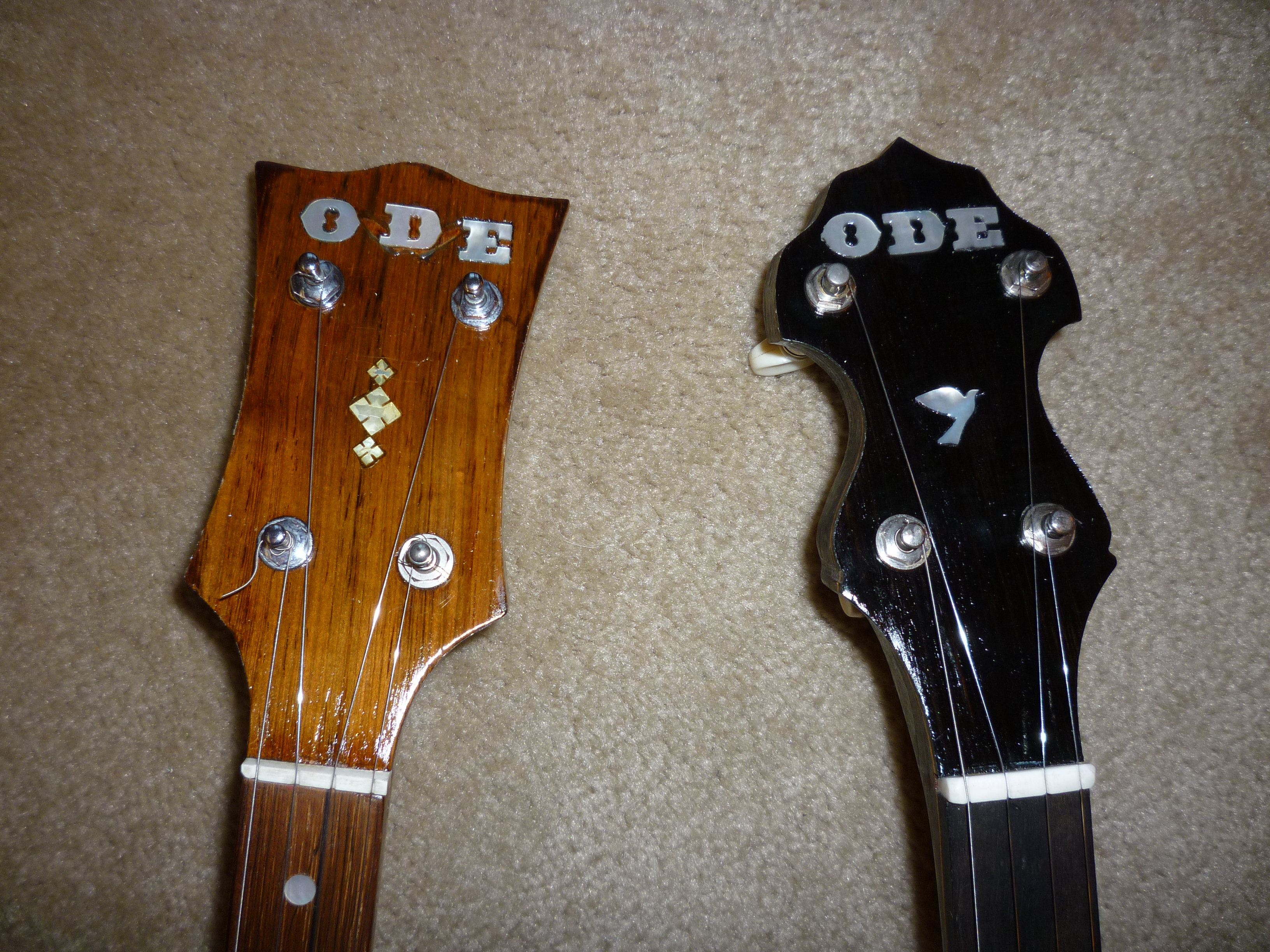 Mother of pearl inlays adorn these two long-neck Ode and Baldwin Ode era banjos with aluminum pots from Boulder, Colorado. The BRC founder has owned the brown banjo since 1971 after buying it from a now prominent folk singer. The black banjo rested in someone’s garage unassembled for almost 40 years until he purchased and restored it. Although the BRC founder is primarily a bluegrass resonator 5 string musician, the mellow tone of the black banjo makes it ideal for quiet around-the-house picking.
Check-out below Comments.