Art Shows

Sky Rover

July 4, 2021

Over the last 63 years, the sprawling annual Art in the Park festival has brought scores of national artists to our university town for an early summer weekend to celebrate creativity and sell their wares. This Spring, however, the June 4-6th event was again canceled for the second year in a row because of covid restrictions.

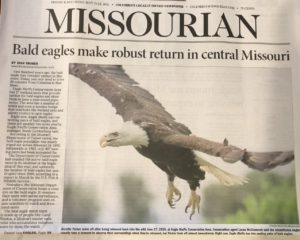
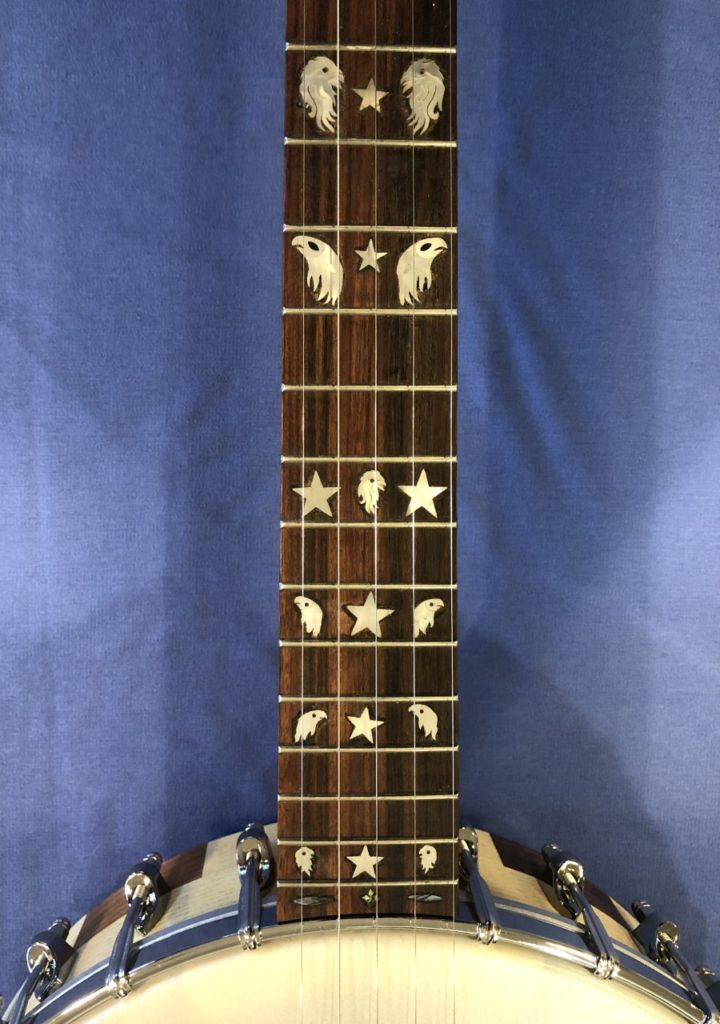
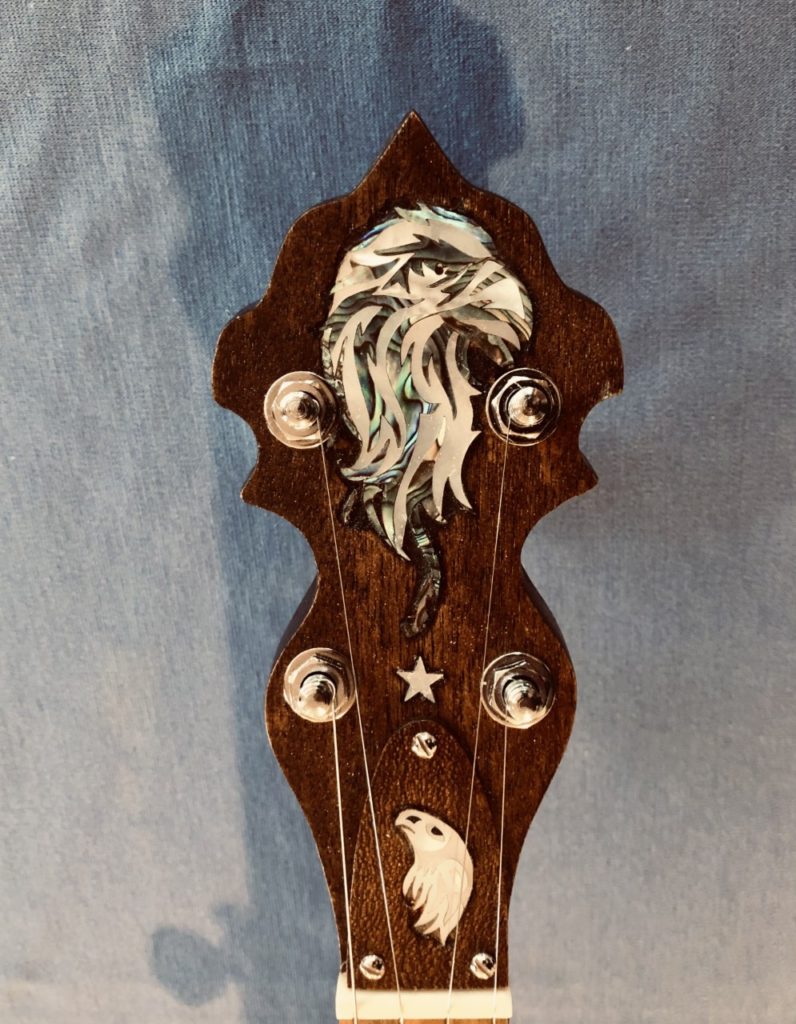
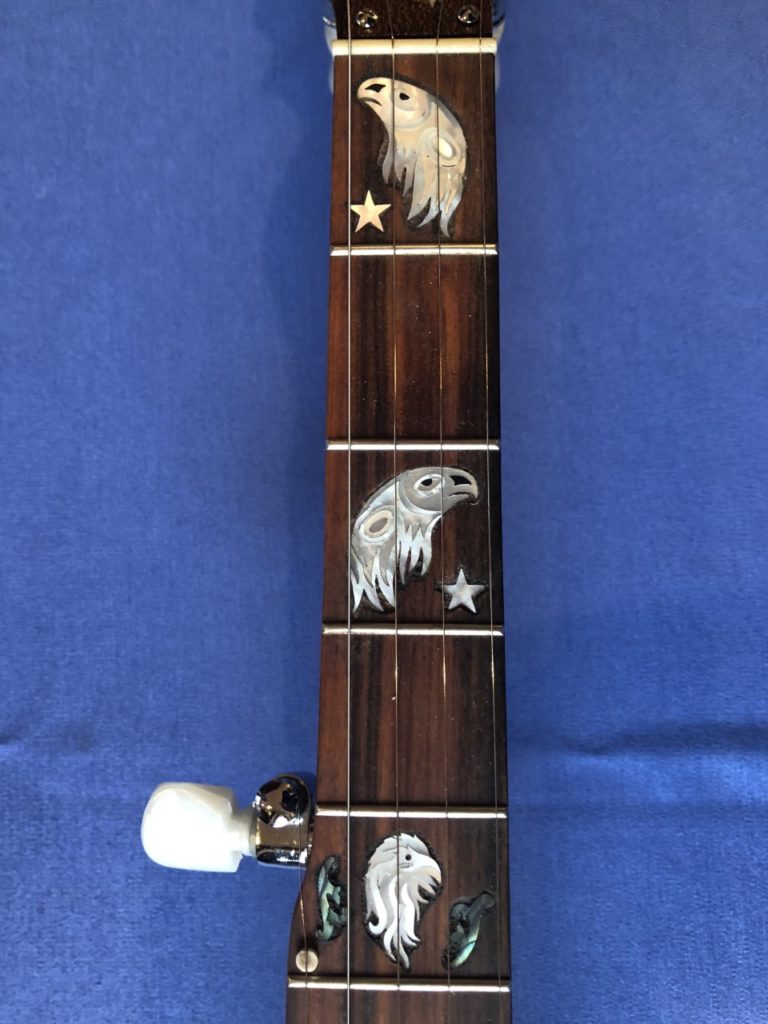
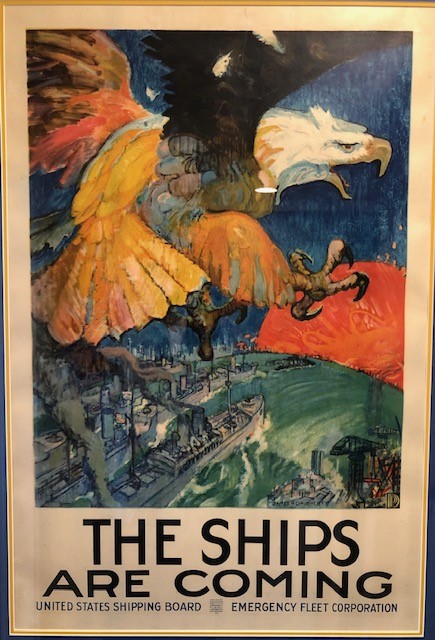
As done in 2020, entries were nonetheless accepted for the Veterans Pavilion tent. These works will be exhibited virtually on line as done last year but supplemented this season with postings on social media and a pop-up display July 17-29 in the lobby gallery of the Central Bank of Boone County, Missouri. The BRC craftsman, a former Air Force serviceman, fashioned a “Sky Rover” banjo that was accepted for the Veterans Tent art show. A life long student of military history, the BRC banjoist has an extensive collection of vintage wartime posters, many of which display bold eagle images as seen below right. The Founding Fathers adopted the eagle as the emblem of our fledgling country because of the fierce beauty and proud independence of the bird. Native Americans revere the eagle because it flies so high and is considered the avian closest to the Creator.


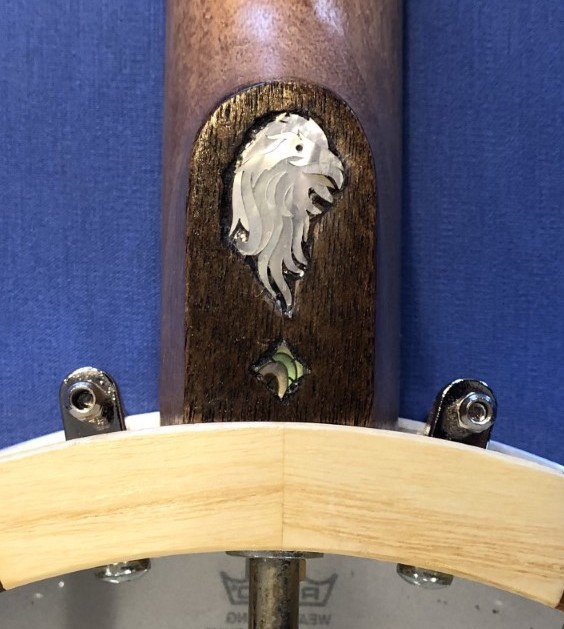
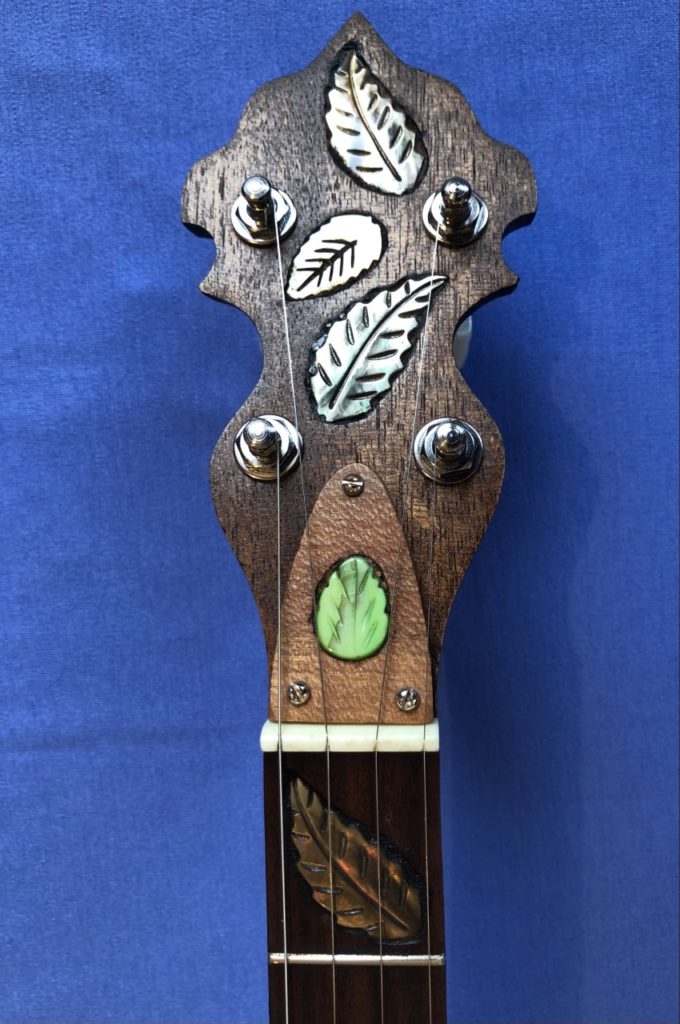
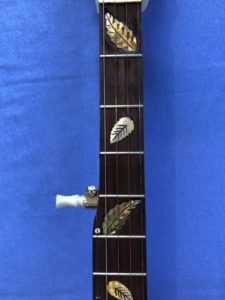
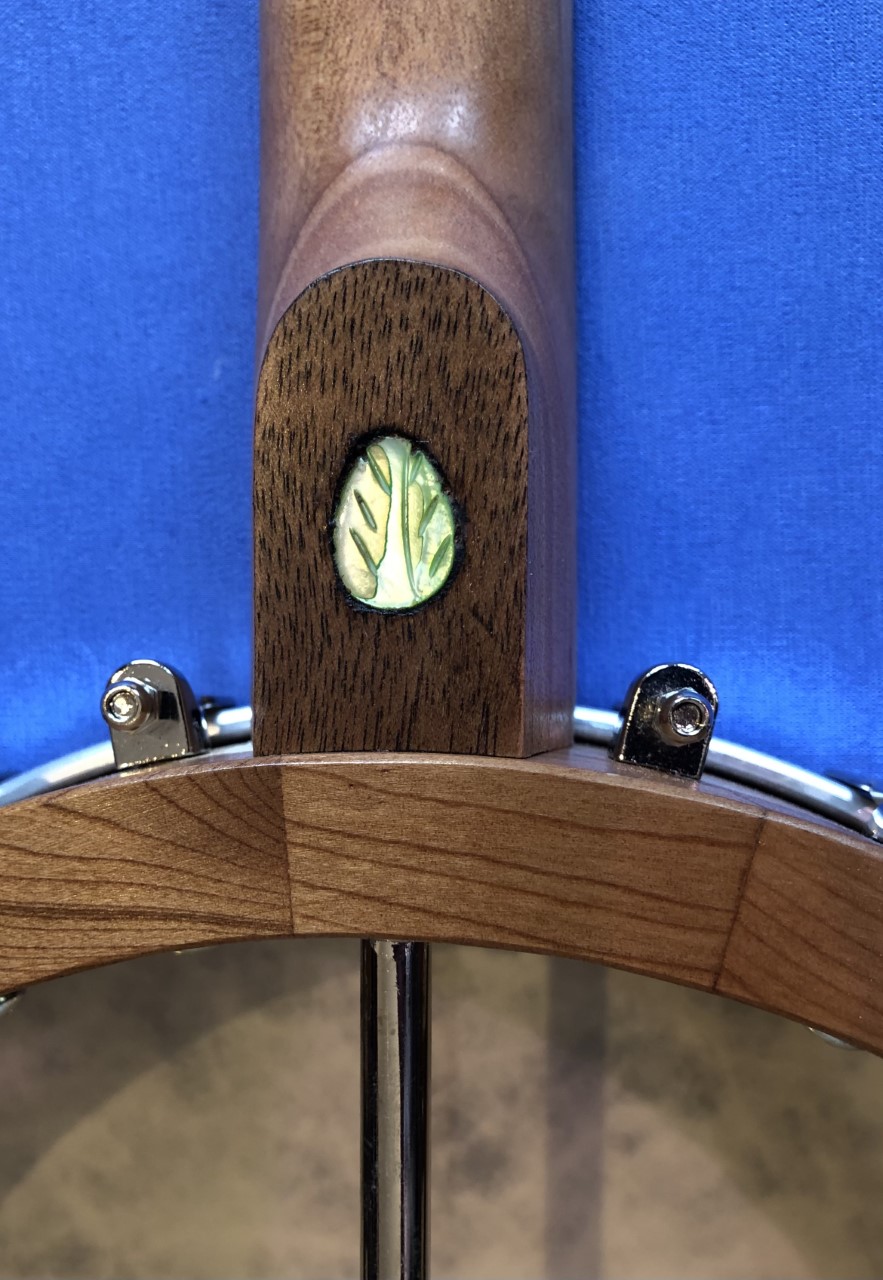
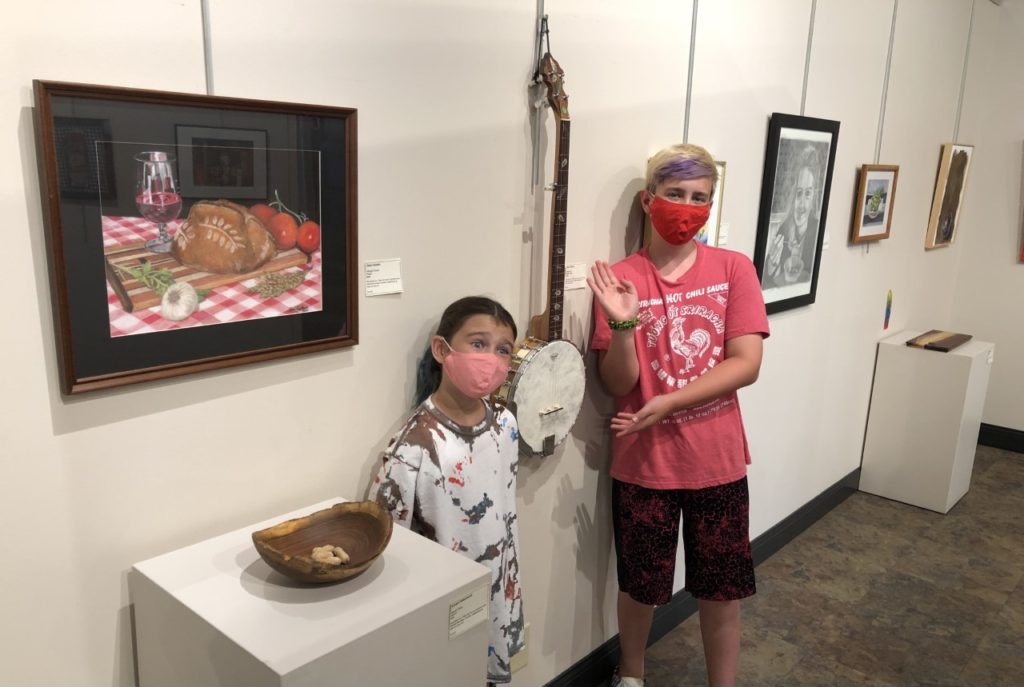
In addition to mother of pearl inlays on the peg head and fretboard of the Sky Rover, the heel of the instrument bears a signature BRC inlay for the eyes only of the musician. In an art league gallery picture below, the BRC craftsman poses with the Sky Rover while it is being photographed for the Veterans Pavilion virtual exhibit. A reception for the contributing Veteran artists is planned at the Central Bank on July 29th at the conclusion of the pop-up exhibit.


From the BRC: Have a restful and healthy Fourth of July weekend.

Vega Martin Stories

Inside a Vega Martin Wonder

June 19, 2021

From the BRC Mailbox:

Dear BRC: Can you help me determine what model my banjo is and what year it was manufactured from the serial number? The number printed inside on the pot is 331. It says CF Martin & Co printed above the number… Any information is appreciated, thanks. D.R.


Dear Reader:

Thank you for the prompt and clear photos as requested. Your instrument # 331 is a “Wonder” model manufactured in Nazareth, PA, at the Martin factory in late 1972. In addition to the C.F. Martin decal on the interior of the pot, a similar and standard decal is located on the back of the peg head as per your photographs. In the 1970 transitional Vega Martin banjo catalogue, this entry level banjo featured a metal tone ring, white fingerboard binding, a heavy notched tension hoop, a 10 ply rim, geared tunings pegs, a 3 piece maple rim, blackwood fingerboard, pearl dots, a resonator with 4 section metal tone flanges, nickel plated metal parts, a plastic head, armrest, and a shaded mahogany finish. In the 1971 C.F. Martin price list, it retailed for $345 without case. The Wonder tone ring was upgraded to brass in the 1976 Vega Martin catalogue.


There is a feature of interest on the interior of this instrument which was assembled not too long after Martin purchased the Vega franchise in 1970. The “VM” initials and abbreviated serial number “31” stamped on both the inner surface of the metal tone ring skirt and on the top of the wooden rim (above) are probably labeling on inventory inherited by C. F. Martin from the Vega workshop where these markings had guided the Boston luthiers in assembling matching parts. A couple of years ago, a website visitor from Europe wrote the BRC Mailbox including a picture of the tone ring on his more up-scale F-VIP Vega Martin banjo made in 1975 which had the matching serial number engraved on the outer tone ring (below) as displayed also on the interior of the pot.

My impression is that this workshop labeling strategy represented a routine Boston quality control measure that was subsequently adopted by C.F. Martin during its banjo building era in Nazareth, PA. We should all make a note to inspect our tone rings for hidden markings when changing the head. Thanks for your query and best wishes from the BRC.

Be well, Barry

Art Shows

Baroque Bur Oak

June 5, 2021

Not far from the hamlet of McBaine (population 10), and just one-half mile from the Missouri River banks, stands what local citizens call “The Big Tree.” This sprawling bur oak is co-holder of the National Championship for the largest tree of its species along with a similar tree in Kentucky. The Big Tree sprouted sometime in the 1600s and is estimated to be 350-400 years old. It is located near the historic Lewis and Clark Trail, and these explorers probably gazed upon its lofty silhouette two centuries ago.

The roadside Big Tree resides on farmland owned by a sixth-generation Show-Me family. This towering oak has survived storms, lightning strikes, 6 foot deep floodwaters from Big Muddy, droughts, vandalism, and spray-painted political graffiti. Bicyclists from the nearby Katy Tail picnic under its leafy shade, and it is not unknown for clergy to contemplatively stroll beneath the mighty skyward reaching branches. Last autumn, after thieves stole its copper grounding cables, a lightning strike set the ancient tree ablaze.

The Boone County Fire Department promptly extinguished the blaze but not before the fire had burned out the core of the tree. Missourians wondered all winter whether enough of the outer nourishing cambium layer of the massive bur oak had been preserved in order to afford its survival. Copper grounding cables were reinstalled as seen below just behind the banjo.

Earlier this spring, the tree`s branches issued tiny delicate buds which soon handsomely leafed out to everyone’s joy and relief. Arborists from the University report that the ancient bur oak has been in decline for a long time but will probably outlive us all. To honor this magnificent and durable Missouri treasure, which has thrived in Heartland soil long before our nation was founded, the local Bur Oak Brewing Company produces a “Big Tree IPA.”

For the Members Only summertime exhibit at the local art league, the BRC craftsman fashioned a ” Baroque Bur Oak” banjo to celebrate the survival of the champion tree.


Amidst 90 entries of oil and watercolor paintings, sculptures, multi-media, and woodworks, the Baroque Bur Oak banjo hangs on a central gallery pillar as a learning opportunity for youngsters.

Last Sunday, the local newspaper celebrated the survival of The Big Tree on the front page.

From the BRC: Preserve our precious environment.

Jamming

Storm`s A`Comin`

May 22, 2021

After a bleak winter of dreary weather punctuated by a bitter polar vortex, the Rock Island McPickers eagerly made springtime plans last month to reinstate their weekly outdoor Wednesday afternoon jam sessions at the municipal park pavilion. Despite dark clouds gathering in the weather forecast on the eve of the jam, the BRC banjoist resolved to journey to the Ozark picking session rain or shine. The next morning, menacing thunderstorms darkened the online weather radar screen, and overnight torrential rains had submerged the municipal park terrain under water.  At the last minute, the jam venue was hurriedly relocated to a nearby church basement.  En route to the newly designated picking place, the BRC craftsman’s windshield was briefly pelleted twice by clusters of mini hail. A McPicker mandolinist urgently communicated that high winds were coming soon, while another observer claimed that the sun was coming out again at the churchyard. The temperature began dropping precipitously in mid Missouri, and a worried clogger cautioned that dime-sized hail had peppered her home earlier in the day. By early afternoon, a tornado warning was issued in a neighboring county despite a local observation that the sun had reemerged near the alternate jam venue. Several musicians, not without some trepidation, slowly filtered into the church basement and proceeded to pick and sing while the storm washed over the building`s steeple and moved-on. Mark Twain is said to have advised, “If you don’t like the weather in Missouri, wait five minutes.” Although still overcast later for the post-jam car ride home to the BRC domicile, the gray skies by late afternoon had quieted. Two nights later, record low temperatures visited the Heartland followed by a snowfall.

A few weeks thereafter, the pickers again planned to reinstitute their weekly Wednesday outdoor jam, but the weather prediction indicated thunderstorms all day. The musicians chose to retreat once more to the church basement while ominous cloud banks roiled overhead. The jam session concluded in the late afternoon during which only a single thunderclap was heard. When the pickers got safely home, monsoon-like rains abruptly fell upon the Heartland obscuring the landscape, and a tornado warning was issued south of the Ozarks. By morning, the spillway at the end of the BRC lake was cascading overflow like a hydroelectric plant to bring the brimming water level down. Such is springtime in Missouri.

From the BRC: Like the four guys above have all ready done, get the vax.

Art Shows

In Retrospect

May 8, 2021

For its springtime “Hindsight is 20/20” exhibit, the local art league challenged its members to submit works offering “..artists the opportunity to reflect on all that we’ve been through over the last year, together and alone; both the triumphs and the tragedies, that which we’ve lost and that which we’ve gained. What has 2020 taught you? The BRC craftsman cultivated an idea to submit a banjo that metaphorically represented the unpredictable and confusing climate of a global pandemic. Over the ages, the study of astrology has been used as a compass heading to plot, understand, or predict the course of human events. Because the novel Covid-19 virus and its mutations have regularly mystified mankind over the last year, the BRC founder fashioned a 5 stringer entitled “Not in the Stars.”


The instrument was designed on a minimalist format with some of its standard guidepost features conspicuously absent to signify our lack of understanding or control of the events around us during the last 13 or more months. The peg head and fingerboard feature zodiac signs which guided some peoples ancient and modern but are of scant utility in the post millennium era of the coronavirus infestation.


On the lower fretboard, a conventional inlay is absent from the 5th fret space (red arrow) which usually serves as a traditional guidepost to orient the musician to that location.


In the upper fingerboard, a bold landmark inlay uniformly at 12th fret space indicating the location of the octave is absent (red arrow). Only small pearly dots along the side of the fretboard identify the significant musical scale intervals for the banjoist. The 22nd (and final) fret space at the neck-pot junction is also left blank, as 2020 could be called the Year of the Information Gap.

For the eyes only of the musician, the heel of the neck (red arrow) is a routine location for a signature BRC inlay, but this personalized emblem is missing. The number 83 indicates this instrument is the 83rd banjo repaired, restored, or built in the BRC workshop. What has 2020 taught you?

A gallery visitor studied “Not in the Stars” and remarked, “Hindsight is always 20/20 in the rearview mirror.”

From the BRC: It is said that after the Plague comes the Renaissance.