CD songs, G&F Band

At the Artisan

December 5, 2020

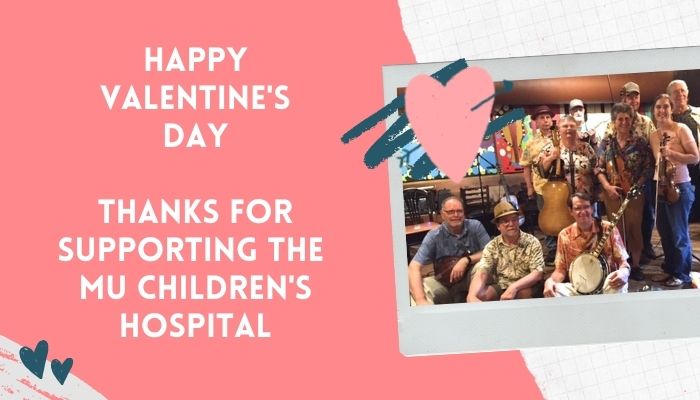
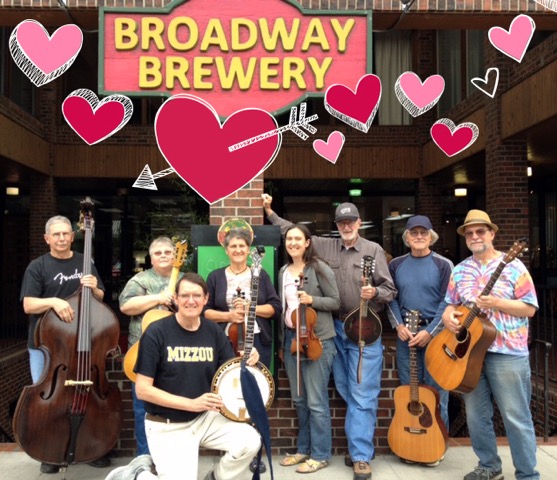
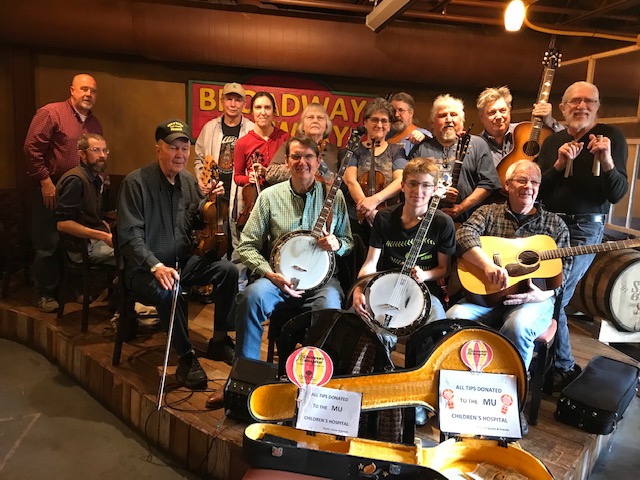
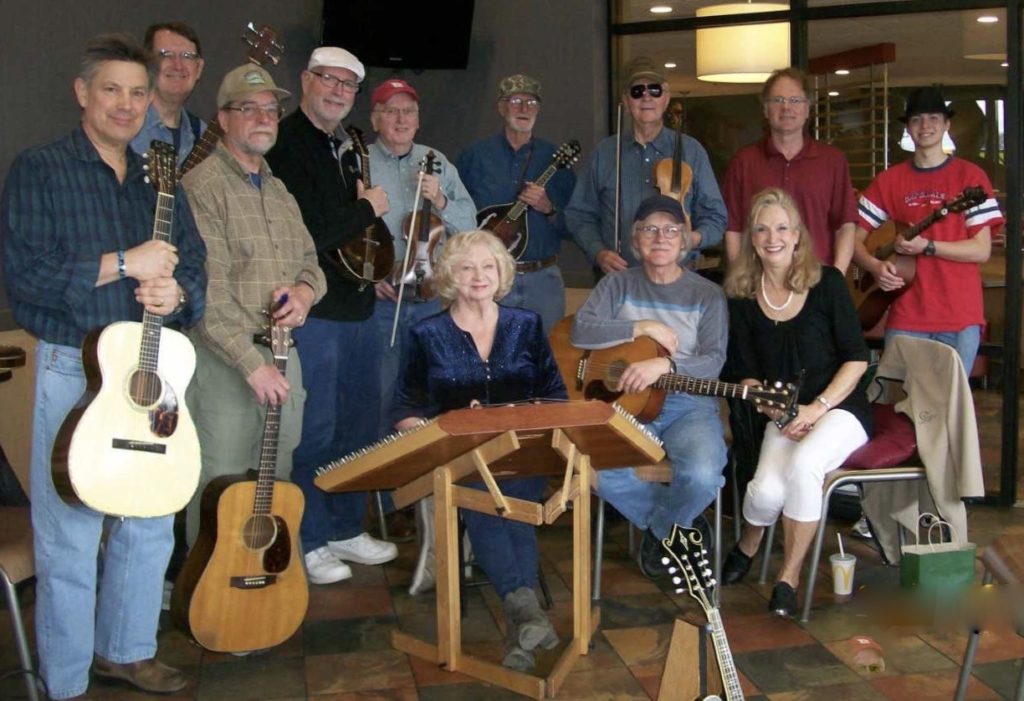
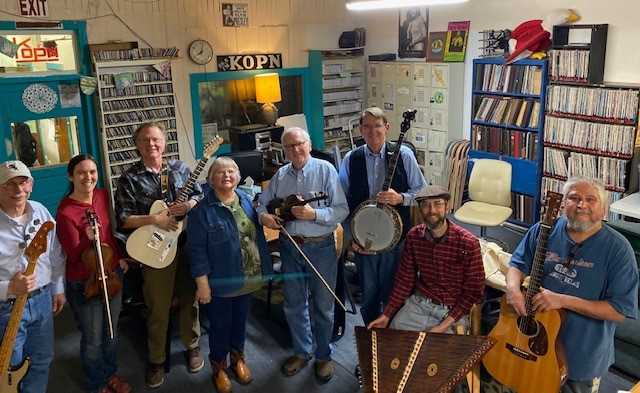
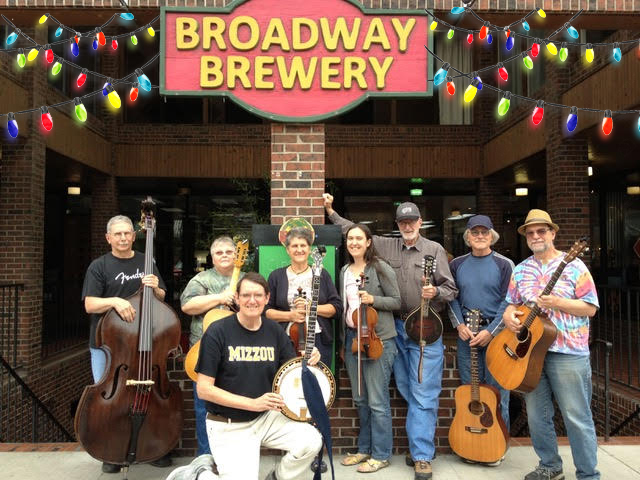
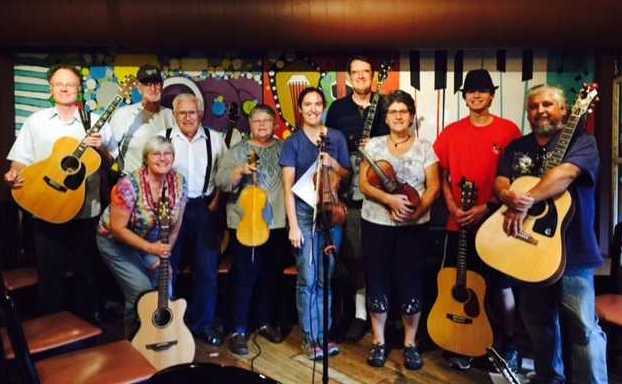
Over the years, the BRC founder`s band has donated all tips to the Children`s Hospital while calling themselves initially the “Bluegrass Jammers” and later the “Moonshyne Reunion.” When the music scene in McBaine dried-up, the BRC banjo-builder began to perform weekly solo gigs at the new Artisan coffee house near the University, a campus that bears the traditional nickname of Mizzou. As the months passed, fellow musicians increasingly began to join him each week on stage, and soon his solo act morphed into what became the “Gainor & Friends” band.


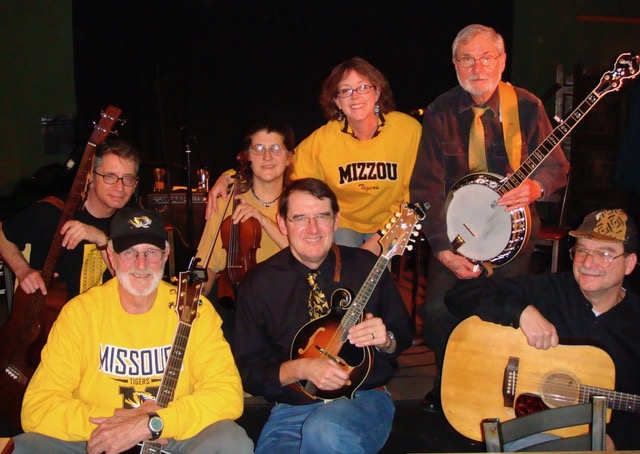
The G&F musicians would wear the Mizzou school colors of black and gold when jamming on the eve of a football game, and the band would perform on holidays in the lobby of the University Hospital to entertain patients, visitors, and staff.

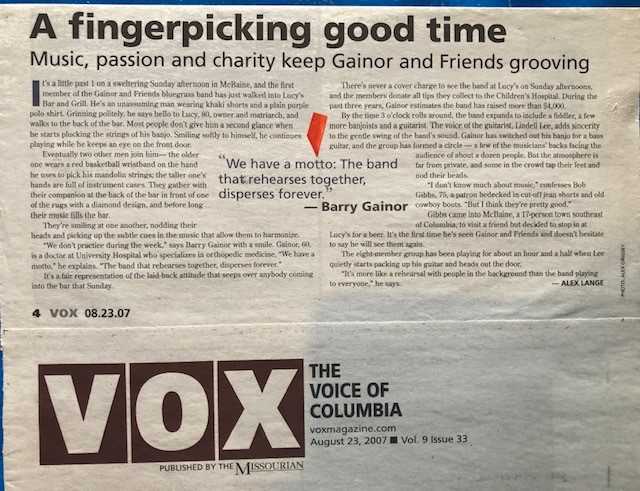
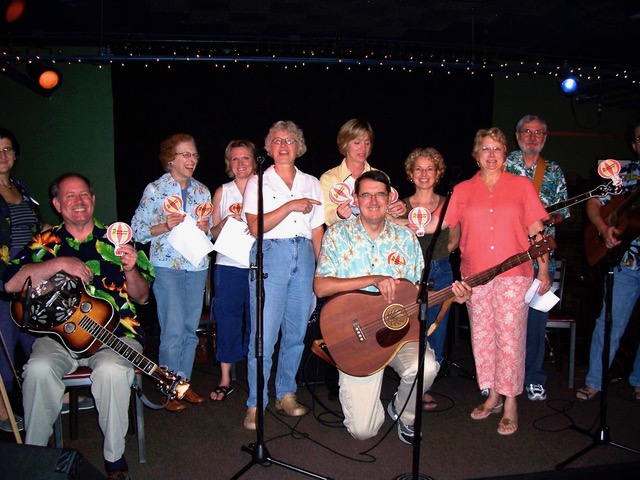
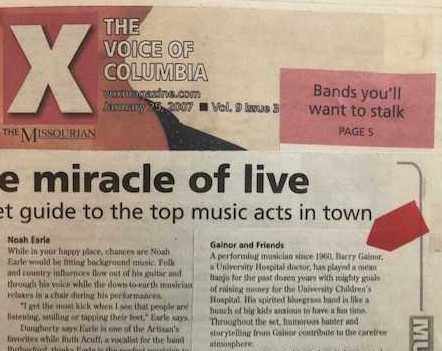
At a benefit gig to collect donations for the Children`s Hospital, nurses join the G&F musicians onstage (above) waving small hand-held logos of the Children’s Miracle Network foundation. While regularly appearing at the Artisan, Gainor & Friends were pleasantly surprised one weekend to discover that they were ranked among the top eight live bands “to stalk” in town per an article (below) in the entertainment section of the local newspaper.

During the jam band’s tenure at the coffee house, the BRC banjo-builder compiled and produced his third and final CD for the Children`s Hospital entitled “Bonesetter`s Best & Bonuses.”

On the disc is one of his favorite self-styled country tunes “Broken Angel” in which the author performs all vocals and music including the keyboard parts. Enjoy the below sound file (Copyright 2006).


From the BRC: be safe, be well, and follow hygiene rules.

Bio

Panoply on the Peninsula

November 21, 2020

Years ago when recently enjoined as a bridegroom and relocating to Florida, the BRC founder and his young wife (pre-nuptial photo right) departed New England motoring south to the Sunshine State and its rich culture of Southeastern traditional music. In addition to his banjo and guitar, he stuffed his cameras and dark room equipment into their Volkswagen bug for the journey.

Concerts and Bluegrass festivals abounded around the university town of Gainesville, and live performances by Bill Monroe and the Bluegrass Boys, Mac Wiseman, Jim & Jesse and the Virginia Boys, Don Reno, the McLain Family, Ralph Stanley & the Clinch Mountain Boys, the Earl Scruggs Revue, Doc and Merle Watson, the Nashville Grass, and the Dillards were attended by the newlyweds. It was the home of the Orange Blossom Special.

When vacationing, the young couple camped along the shores of the Florida Keys and admired the playful dolphins in the surf. They visited the Everglades National Park to learn about its ecosystem, wildlife, and indigenous people.

In a storage room in their house, the BRC banjo-builder constructed a dark room to develop his photo essays of musicians like the above side walk trio entertaining at a street festival in the sleepy Gulf coast fishing village of Cedar Key while three somnolent canines doze at their feet.

Busy with medical training and starting a family with his spouse, his music and songwriting a took a back seat to the hobby of photographing their youngsters as the kids grew-up.

There are several species of dolphins that ply the coastal waters of Florida. They are intelligent, social creatures that form pods of 2-3 adults and groups sometimes up to 15. Dolphins are warm-blooded mammals that phonate a “signature whistle’ to communicate and use “clicking” like sonar to facilitate navigation. Pods have complex social structures that manifest cooperative hunting strategies. Dolphin populations are threatened by commercial fishing, propeller strikes, and oil spills.

For the community art league`s annual winter Gift of Art Show, the BRC founder submitted his “Dolphin Songs” banjo. This 5-stringer was originally fashioned for the yearly Boone County Bank gala art exhibit which was cancelled this autumn because of the pandemic. Note the paua abalone treble clefs in the truss rod cover and fretboard.

The BRC banjo was prominently displayed among a field of 80 works including pastel, watercolor and oil paintings, bronze, wood, and metal works, and an array of photographic imagery.

From the BRC: Have a restful Thanksgiving weekend. Be safe, wear a mask, keep on picking.

G&F Band, Jamming

Lucy the Barmaid

November 7, 2020

Not long after the unfortunate demise and closure of the “Country Club” jam locale, a restaurant cook named Lucy decided to move back to the rural township of McBaine for her retirement years and open a pub in an empty storefront. She promptly invited our Sunday jam session to move-in, and we so did gratefully. The pub was just a stone’s throw from the defunct Missouri-Kansas-Texas railroad line that had been converted into a bike trail. A replica whistle stop station nearby provided a panel of archival photos from the days when a steam-engine locomotive shuttled a daily train of rural folks to and from the neighboring university town. A banjo picker and bassist frequently bike the MKT or “Katy” Trail that parallels the Missouri River.

Because of the proximity of “Lucy’s” pub to the university town, the School of Journalism students took interest in the jam session site. YouTube enthusiasts videotaped the musicians. Links to YouTube jam clips are below:

https://www.youtube.com/watch?v=67j4l1ue5QY

https://www.youtube.com/watch?v=j_tIbrexWgM

Although the Missouri River Flood of 2005 submerged Lucy’s pub under 5 feet of water, the proprietor afterwards restored the premises for patrons and pickers while she readied to fully retire. As a special thank-you for her generosity to us and our listeners, the BRC founder penned the farewell tune “Sweet Lucy.” One Sunday afternoon when her girlfriends stopped-by the pub for tea time, Lucy requested the writer who gladly agreed to perform the song for them. The tune brought smiles all around. A few years later, he attended Lucy`s funeral along with her many, many admiring friends.

On the below “Sweet Lucy” sound file, all music and vocals are performed by the author as recorded on his 2005 CD “Songs about the Heartland” which benefitted the Children’s Hospital. Enjoy.


From the BRC: Be safe, follow hygiene rules, and keep on picking.

CD songs, Cell Perches & HVO

Social Distancing & Masks & Win

October 24, 2020

In the mid 1980`s,the BRC founder joined Health Volunteers Overseas (HVO) which is a non governmental organization (NGO) based in our nation`s capital and dedicated to providing medical care and education in resource poor countries in the developing world. Over the years, the BRC founder served overseas assignments and held leadership positions in the organization. In 2006, the executive director asked him to record a CD of original music to celebrate the 20th anniversary of HVO.

In a period of 10 days, the BRC founder drafted and scored a fund-raising album of songs for HVO entitled “Compass Points” which chronicled the challenges, fulfillments, and humorous adventures of international medical volunteerism. He recruited a trio of grand nieces to provide back-up vocals, as pictured above with him in a Chicago recording studio, and the fund-raising CD was marketed by the non- profit HVO office in Washington, D.C..   

In April of 2020, the executive director asked the BRC founder to make a music video for the HVO Facebook Homepage to celebrate World Health Care Workers Week. Click on the below video link and enjoy his desktop rendition of “Are You Looking for an NGO?”

https://www.facebook.com/hvousa/videos/3767106190028071/

The “Compass Points” CD contains a true story and cautionary tale about the importance of physical distancing when in the presence of a health hazard. Sound familiar? Many years ago on the Carribean island of St. Lucia, when the BRC founder and his family were there on volunteer medical assignment at St. Jude Hospital, a vacation hotel went bankrupt and abandoned their pet elephant “Bupa” to roam the tropical island. In the below picture of Bupa, note that the islanders (far left) are keeping safe distance from the unpredictable pachyderm.

Enjoy the attached calypso -styled sound file of “Bupa the Elephant” and especially the back-up vocals by our young trio of singing sisters. All the music was multi-tracked by the author (Copyright 2006).

Fast forwarding to stateside these days, the BRC founder and fellow musicians mask-up weekly at the Rock Island Municipal Park pavilion for an outdoor Ozark jam session.

The popular TV series “Petticoat Junction” that aired 1963-1970 was based on the old Burris Hotel in Eldon, Missouri, that was previously called the Rock Island Hotel because it was on the Rock Island Railroad Line. The granddaughter of the hotel owner was the wife of the creator and executive producer of the television show, and she visited the hotel often in her youth. She shared her fond memories of it and the people there with her spouse who used this story to model the Shady Rest Hotel setting and characters of the TV series. The hotel and railroad line are now gone, but the namesake Rock Island Municipal Park stands nearby in tribute today. Flatt and Scruggs played the theme music for the Petticoat Junction TV show. The above jam session musicians informally call themselves the Rock Island Rangers.

In a field of 4 submissions to the Gainor & Friends scary Halloween jam photo contest this month, a pre-pandemic picture of the Rock Island Rangers with a rusty van was the winner by a majority vote. Congrats to the Ozark pickers.

From the BRC: Be safe, observe social distancing, and wear a mask.

CD songs, Jamming, Vega Martin Stories

The Iron Horse is Gone & Down Under- Vega

October 10, 2020

The Salamander Grill proprietors relocated their business up river 30 miles and renamed it the “Cowboy Toad.” Our Bluegrass jam emigrated to a nearby and newly built restaurant called the “Country Club” which was a two story wooden structure across the highway from the Eagles Bluff Conservation Area- a wildlife preserve beautifully photographed in the nature book “Where Pelicans Fly.” The Club was situated in the almost abandoned old railroad town of McBaine, Missouri, population 10.

The jam session area sported a “MU” wall placard and an emblematic Tiger visage beside it because the highway out front eventually coursed all the way back into town accessing the University of Missouri campus. For several years, the Country Club was a popular Sunday afternoon rendezvous site for pickers, patrons, and bicyclists pedaling along the nearby Katy Trail. The BRC founder wrote a bouncy blues tune entitled the “McBaine Boogie” for the listeners.

Late one night, the Country Club sadly burned down. After the conflagration, an anonymous music fan wrote a nostalgic poem that appeared in the local newspaper.


Attached is a sound file of the “McBaine Boogie.” All parts are performed by the author on this opening track of his 2004 CD benefitting the University of Missouri Children`s Hospital. Enjoy.

McBaine Boogie from the Hartsburg Anthology (Copyright 2004).

From the BRC Vega Martin Mailbox:

D.M. from Australia writes-

Hi there, just found your page; what a fantastic site for resources about Vega Martin Banjos! I’ve just recently picked up a Vega Plectrum Banjo here in Australia which has turned out to be a bit of a mystery. It’s a Pro-II which is in quite good condition; it even has the original Lifton case, complete with all the case candy! From what I can see, everything about it suggests that it’s one of the later Instruments made prior to the buyout (it has the reshaped headstock).

However here’s the interesting part; instead of the usual yellow label inside, it has a white label marked Needham Heights with a 5 digit serial number!

At first I was worried that I might have scored a fake; however I managed to google one other banjo with the same label (& a similar serial number) that the owner seemed to think was from 1970, which I believe would make it a transitional model. Interestingly, the 5 digit serial number is preceded by the letter “B” handwritten on the label (I’m guessing that this may have been so the serial numbers don’t overlap with serial numbers from the “print error” models in ’63-’64?). Have you come across the white labels before; and if so, would you have any idea when & where the Banjo might have been made? If I can get an email for you I’ll send you some pics. Cheers, D.M.

Reply from the BRC:

Dear D.M.-

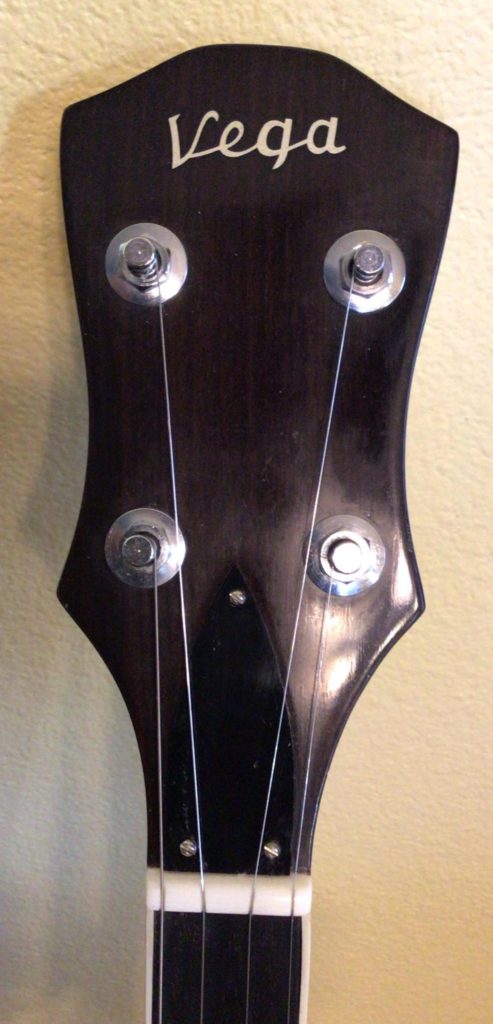
Thanks for the prompt and detailed pictures of your Vega Pro II plectrum banjo #B-12163 with its serial number curiously recorded on an unusual white, rather than yellow, label sticker. Your banjo (seen above) was manufactured in 1964 during a brief period when Vega used 5 digit serial numbers because of a printer`s error and when a prefix of “A” meant an adjustable truss rod. The peg head on the Pro line of banjos seen in the 1963, 1966, and 1968 Vega catalogues is more squarish with somewhat pointy corners than the peg head shown on your 4-stringer. In the 1966 Vega/Boston catalog, the Pro fretboard replaced its blockish mother of pearl inlays with your instrument`s  “football and crowns” designs. When the new VIP series was introduced in the 1968 Vega catalogue, it featured an identical MOP stye on its fingerboard but a more smoothly contoured peg head. For about 2 years after acquiring the Vega brand in 1970, C.F. Martin continued the traditional Vega yellow label sticker with the historic 6 digit serial number system but prefixed it with the letter “M” to signify new ownership.

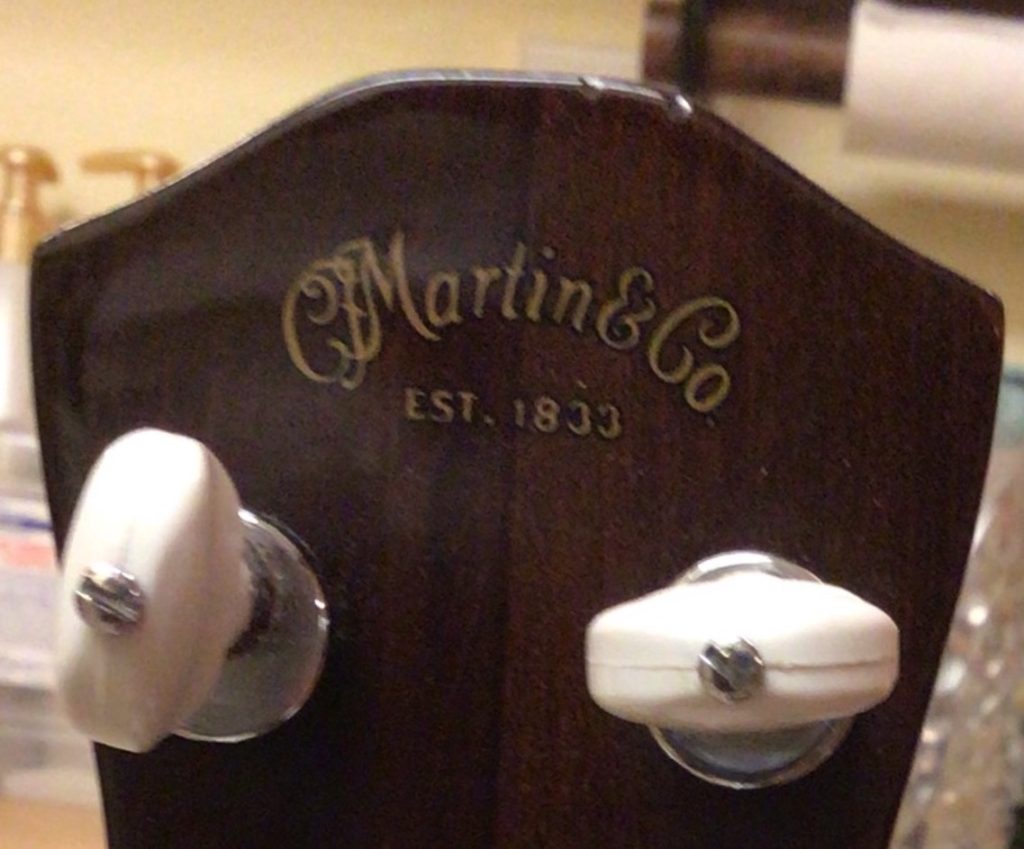
Martin initiated its own serial number system decaled on the interior of the wooden pots starting in 1972. The so-called Bobby Joe Fenster banjo in the Vega Martin catalog of 1970, a thinly veiled Pro model, featured the more smoothly contoured peg head from the VIP neck series. In the C.F. Martin catalogue of 1972, the bona fide Pro model reemerged featuring the smoothly contoured VIP peg head with its rounded corners. The popular VIP model featured more elaborate MOP inlays in the peg head than its cousin the Professional (as seen below in the 1975 Vega Martin VIP-5 banjo #1364 in the BRC collection).

Of note, the Vega factory moved from Leon St. in Boston to Reservoir St. in Needham Heights, Massachusetts, in 1966. My primary theory is that your “B” banjo was a 1964 workshop prototype experimenting with converting the squarish original Pro peg head with its pointy corners to the more smoothly contoured peg head style of the future VIP series. To distinguish this prototype Pro II banjo from the regular inventory, a distinctive white sticker label with a “B” prefixing the serial number was installed to designate the instrument`s unique status to the Vega planners. Interestingly, no model identification appears on the original small Vega ID tag displayed in your photographs. My secondary theory is that your “B” banjo was built from parts manufactured or assembled in Boston, but it was not marketed until sometime later after the factory relocated to Needham Heights. A combination of both of these theories may be the actuality.  Lastly, the unusual white sticker label seen in 1963-64 might be just another printer`s error. Hope this helps and thanks again for the photos and interesting supplemental data. Be well Down Under, Barry

D.M. replies, Oct. 2, 2020

Hey Barry, thank you so much for that reply. Wow, sounds like it’s an interesting one; I do remember reading somewhere that Vega weren’t afraid to experiment! Thanks for solving that; and thanks again for your info. D. M.

To All: Be well, mask-up, keep on picking.