Art Shows

Seafaring Stranger & the Smithy

July 15, 2019

Clouded in mystery, the narwhal is the “unicorn of the sea” and first cousin to the beluga whale. Although a reclusive creature, the narwhal is a mammal that plies the Arctic waters in pods ranging from 10 to 100. It grows to 13-18 feet and can weigh up to 3500 pounds. Its swordlike tusk, which is actually a twisted tooth, can be sometimes 8 feet long and occasionally doubled in males. It is estimated that the population of this legendary deep diving (1300-4500 ft.) sea creature is 50K-170K.  Although not an endangered species, the narwhal is vulnerable to climate change. Its predators are polar bears that lurk at ice holes, and orcas that attack pods. Inspiration for a seafaring themed BRC 5-stringer came from a family trip to the island of Nantucket last summer and a visit to its Whaling Museum.IMG_0542

Amidst 113 paintings, sculptures, photographs, and mixed media works at the community Art League`s summer show, the BRC founder`s banjo “Seeking the Narwhal” hangs on a central pillar adjacent to his wife’s painting “River in the Woods.”  His spouse is seen discussing her oil painting with a curious patron while the banjo attracts little notice.

AIMG_0547t the gala opening reception, however, The Narwal garnered a ribbon and was promptly purchased by a local blacksmith who forges metal sculptures for Art League shows.


The blacksmith then invited the banjo builder and grandkids to a tour of his smithy for a metal art demonstration, and the skillful artisan is pictured below at his anvil with hammer in hand.IMG_0558

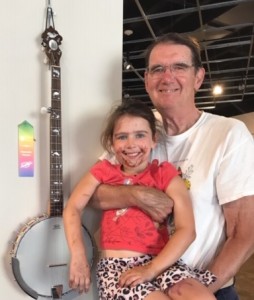
A BRC granddaughter, whose favorite sea animal is the narwhal, later celebrated the ribbon and metal shop tour with an ice cream treat.
IMG_1892 (1) (1)

Cell Perches & HVO

Double Siege

July 1, 2019

Just over a month ago, our nearby capital city was besieged with a tornado followed promptly by flooding from the rain-swollen Missouri River. Fortunately, there were no fatalities from theses calamities, but the townspeople still reel from the exhausting impact of two almost simultaneous natural disasters and troublesome resurging water levels of the river.IMG_2624


On the night of the tornado, a Facebook photo captured the roiling tumult of a malevolent tornado-spawning cloud as it churned across the outskirts of the city.  Shortly thereafter, the cresting Missouri River breached its banks and spilled into the midtown area and over miles of surrounding floodplains.

IMG_0502


With the capital building dome seen faintly in the distant mid photo, sandbags stand guard over unpredictable flood waters that threaten an off ramp approach to the Jefferson City Bridge near the submerged municipal airport.

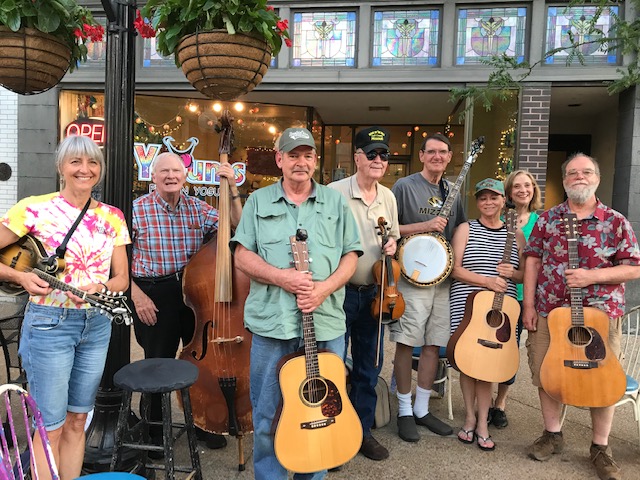
The flood tide finally relented and started to slowly ebb weeks later, and folks began to recover from the storm damage. Bluegrass musicians gathered at a capital city yogurt shop for a sidewalk summer jam. Children and passers-by applauded the cheerful homespun music and harmony singing, and our clogger instructed dance steps to those daring enough to kick-up their heels.IMG_1871

Heartened by the rebounding festive community spirit, an on-looking citizen exclaimed,  “This is what Jefferson City needs!”

Antique Banjos

Motto Revisited

June 17, 2019

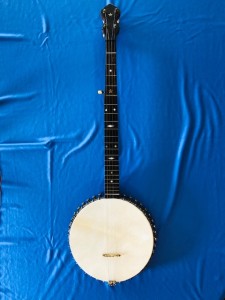
The recent `No Knot` 5-stringer restoration pointedly reminded the BRC founder of his website motto: All Banjos Deserve a Second Chance. Postponing plans to build a banjo for an upcoming art show, he earnestly set out to restore a dreary and deeply tarnished antique instrument that had been languishing for months under a table in the workshop.IMG_0462

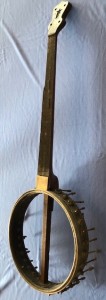
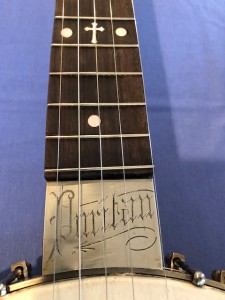
The fretboard and tuning pegs were gone, mother of pearl inlays in the peg head were fragmented or absent, no remnant of a head remained, and much of the hardware was pitted with rust. The base of the neck had a smudged plaque embossed with ” Puritan.”

Research revealed that this circa 1895 banjo was likely made in Chicago by the Lyon & Healy Company that also marketed similar 5 -stringers with plaques labeled “Mystic” or “President” and sometimes  “Encore.” Unique structural features at the neck-rim junction indicate that this model was a student/intermediate level instrument.

IMG_0476


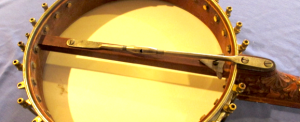
In comparison, some high end 5-stringers of that era had the familiar neck brace-cross pin used to stabilize the dowel stick-pot junction as seen in this circa 1900  banjo. It is not known when this mechanically dependable device was invented, but it is ubiquitous today and bears no patent data.


Less expensive turn of the century banjos, as seen in this archival picture from the BRC collection, frequently had only one or two wood screws across the pot or dowel stick-neck interface. A supplemental stout metal brace spanning the construct was not ornamental but integral in stabilizing the junction.

Untitled copy 3


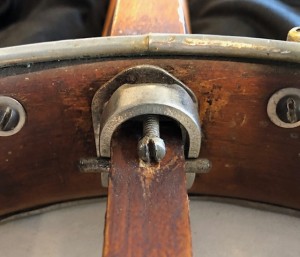
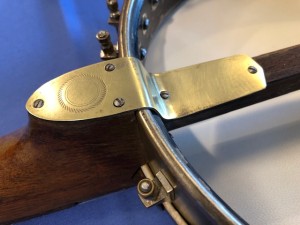
The “Puritan” had a well-secured and engraved buttress plate made of brass that reenforced the two wood screws hidden below it clasping the pot to the heel of the neck. IMG_0533


The inner wooden pot was  “spun over” and clad with a German silver (nickel , copper, and zinc alloy) outer rim. Some collectors admire this shiny antique feature and the tone it reportedly imparts to the banjo. A new rosewood fretboard was fretted and installed, and it was modestly inlayed with mother of pearl. The recessed “Puritan” plaque at the base of the neck offered a profile that looks like a forerunner of the modern day `scooped` fingerboard.IMG_0528 (2)


Clawhammer enthusiasts would probably concur that all banjos, especially an open-back treasure like this one, deserve a second chance.

Antique Banjos

Upon Closer Inspection

June 3, 2019

IMG_0459When this antique and unmarked banjo first appeared in the BRC workshop, it was a forlorn grime covered instrument with a detached fretboard, fractured or missing mother of pearl inlays, and a yellow brown calfskin head that had dried into parched shoe leather.
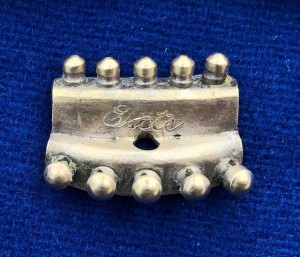
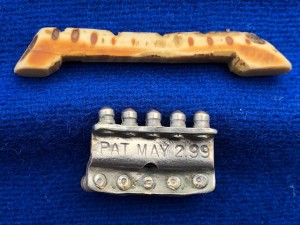
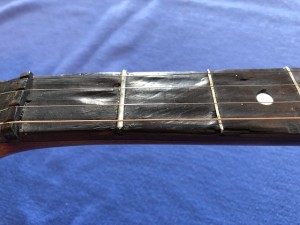
For months, it collected dust in an ignored corner of the shop before it finally won the attention that it deserved. A meticulous clean-up surprisingly disclosed an Elite “No Knot” tailpiece that was known to be applied to high grade 5-stringers at the turn of the century.

IMG_0263


On the under surface of the tailpiece was a patent date of May 2, 1899.  There were several patents of this unique No-Knot tailpiece from 1892 to 1914 to accommodate various models of banjo. The ancient bridge appears to have been carved from whalebone. Scrimshaw and whale bone carving were a sailor`s past time at sea until the whaling industry ended in the US in 1927.IMG_0412


Upon closer inspection, the fretboard revealed deep fingertip grooves in the first 3 frets spaces indicating that this instrument had been industriously played by its owner who obviously cherished its music. Missing frets were replaced, and the mother of pearl inlays were patched -up. For a facelift, a snowy white new calfskin head was installed.IMG_0438


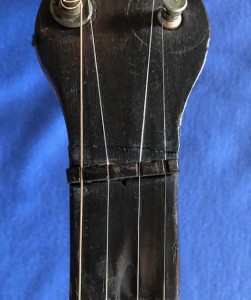
Lastly, the nut at the base of the peg head was noted to be angled slightly, and this is interpreted to be a calculated design feature to compensate for string length intonation usually accommodated in modern bridges.  Of note, Stelling banjos have string compensations slotted into the nut.IMG_0446


This handsome banjo now hangs at the top of the stairwell leading to our workshop to remind the BRC founder that even the most humblest of old banjos has a story.

Bio

Thanks a Million

May 20, 2019

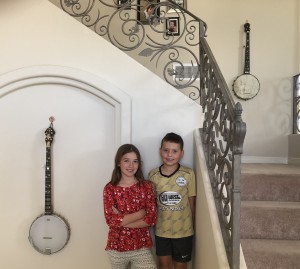
The BRC founder`s son, also a musician, set up the Banjo Rehabilitation Center website for the pater familias in April of 2011, as his dad`s computer skills were not advanced enough to engineer such a cyber task. Our son`s two children are pictured below in the foyer of his Texas homestead.IMG_E0101

Over the ensuing years, the BRC founder  has slowly but steadfastly expanded his techno-skills to maintain and upgrade the website. Letters from across the English speaking world are chronicled in the BRC Mailbox under the Vega Martin Banjo Info header.  The Hall of Fame is a pantheon of special BRC friends. This month, our website search engine hits incredibly surpassed the milestone of one million.

IMG_0245


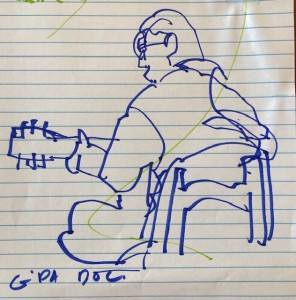
At family gatherings, the grandchildren always have a songfest with the BRC founder who accompanies them on guitar. A son-in-law, an architect, recently drafted a quick sketch of the kids` song leader and labeled it “G`pa Doc.”


IMG_0239


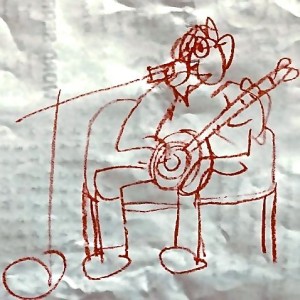
After singing on stage with his grandfather at the local brewpub not too long ago, a Chicago grandchild drew a crayon likeness of his BRC banjo guy. What a lucky grandpa.

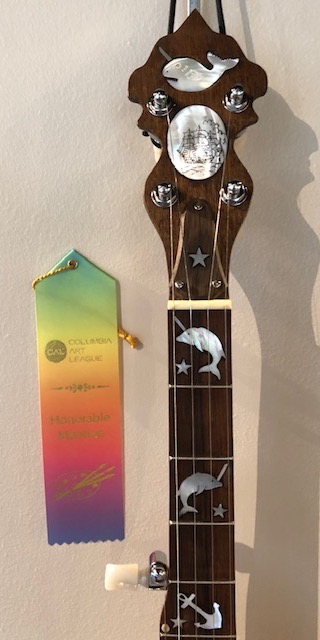
This last week at the art gallery where his “St. Paddy`s Partita”  5-stringer and award ribbon are on display, the BRC founder conducted an interactive dialogue on banjo building with a young group of “Grade A Plus” students from an after school academic support and enrichment program.

He has many blessings- more than a million of  them.