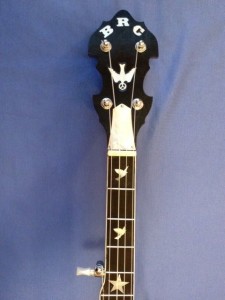
From 1893 to 1901, the Sears and Roebuck Company contracted with S.S. Stewart Co. of Philadelphia to build banjos for sale as the `Acme` brand via catalogue marketing. Most but not all of these instruments bore the `Acme` label, and a few had incidental `S.S. Stewart’ markings. Some banjos were unmarked but clearly an S.S. Stewart product, although the Bay State and Luscomb manufacturers made strikingly similar designs in that era probably in response to buyer preference.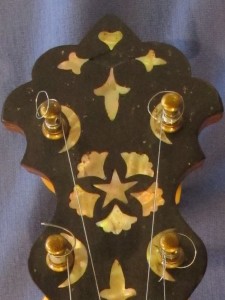
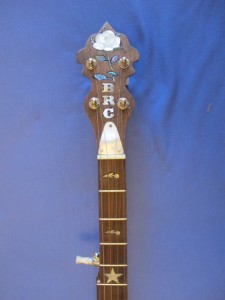
One such unmarked but well-crafted 5 stringer appeared for repairs in the BRC workshop this autumn. The tip of the peg head of this high-end instrument had a subtle absent white mother of pearl diamond amidst a cluster of 4 intact inlays.
Two yellow abalone inlays (arrows) were missing from the upper fretboard`s elaborately engraved wreath and wire floral pattern, and small wood chips were fractured off the neck- pot junction area.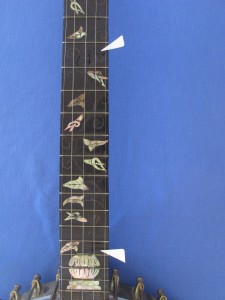
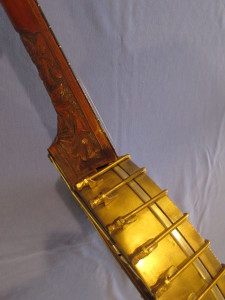
The spun over rim, brackets, and talon tailpiece had a soft golden hue suggesting an unplated brass alloy, and the heel of the neck was festooned with handsome wood carvings.
The color tone of the inlays had aged significantly over the last century, and newly installed white mother of pearl was at least a half-tone different from the native peg head inlay.
A similar yellow abalone to somewhat match the discolored fretboard decorations was hard to locate but eventually obtained from a shop in Taiwan.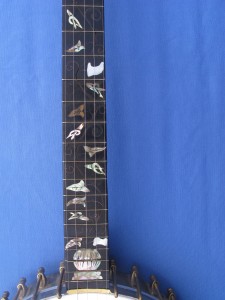
The neck had no truss rod and about a 5 degree forward bend to it. The inlay pattern and wood defects were patched-up gently because the wood was so dried-up and fragile that it was prone to crumble.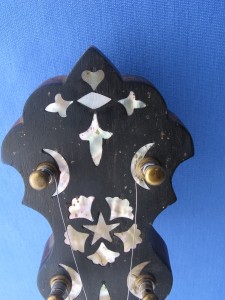
The owner was advised to get nylon strings to prevent further deformity of the neck of this vintage banjo that still had a charming and warm tone.
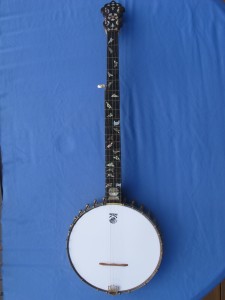
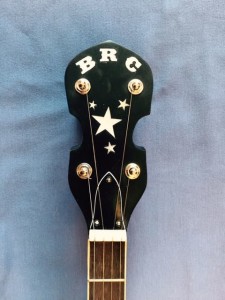
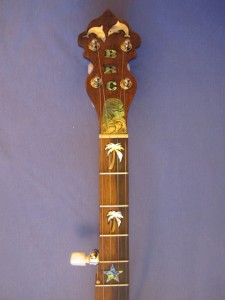
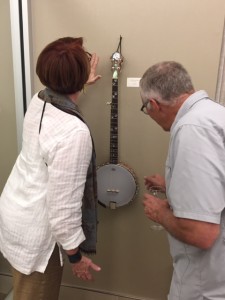 Behind a row of sculptures in a quiet corner of the 58th Annual Boone County Art Show , a “Tiger Burning Bright” banjo patiently hangs inviting the inquisitive eyes of patrons. This feline 5- stringer is named after one of the BRC founder`s favorite poems written by William Blake (1757-1827).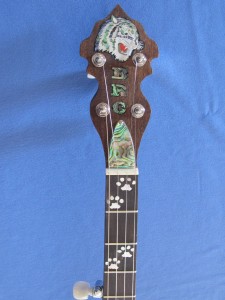
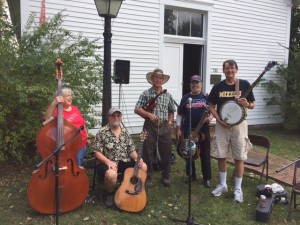
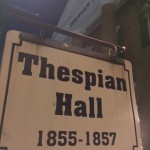
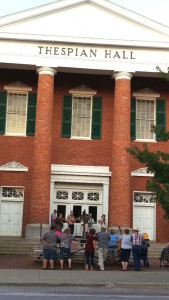
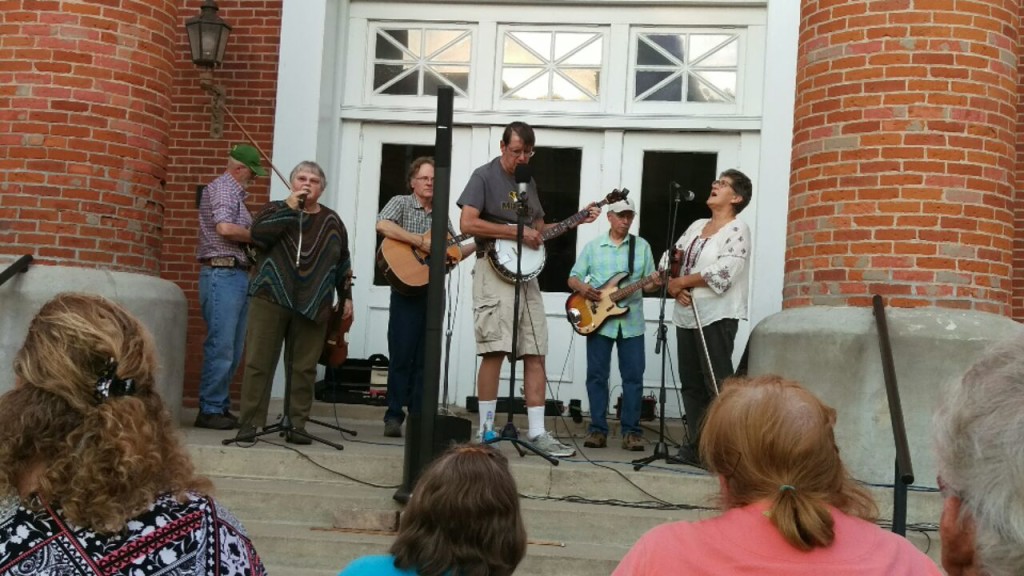
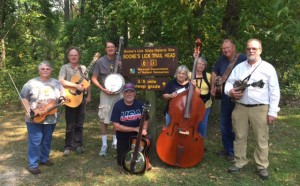
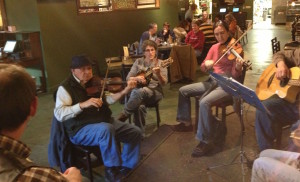
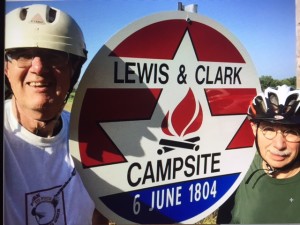 The largest salt spring was `Boone`s Lick’ named after two of pioneer Daniel Boone`s sons , Nathan and Daniel, who partnered-up with two other entrepreneurs in 1805 to harvest commercial salt. A few remnants of their frontier work site remain on the grounds of what is now the Boonslick State Park. It is the site of a yearly autumn Folk Festival featuring local arts and crafts and traditional Missouri music. An enthusiast exhibits a spectacular Indian arrowhead collection, and storytelling Civil War reenactors have a booth of relics.